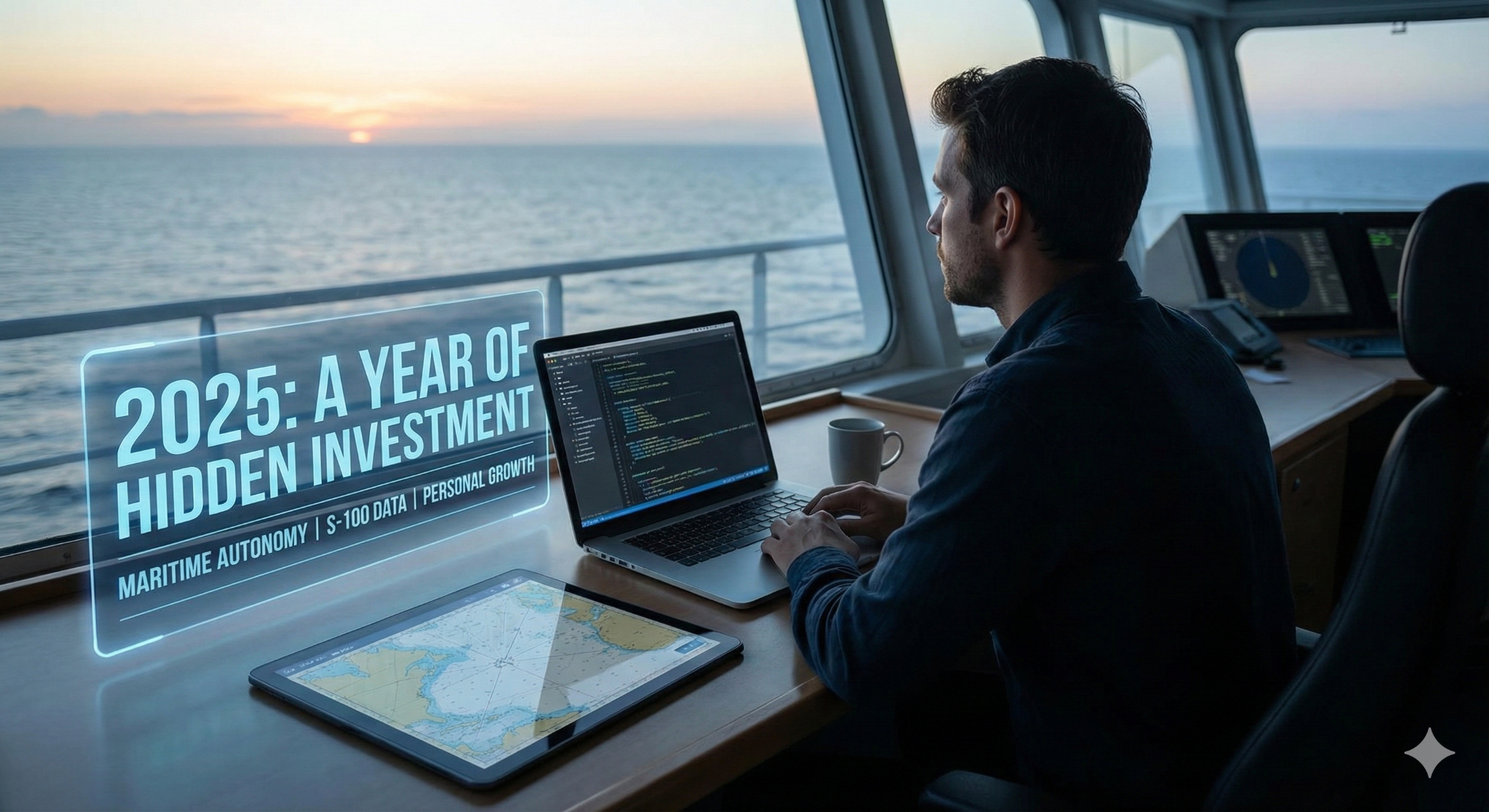
As the year comes to an end, it feels natural to pause and reflect on what the past twelve months have brought. This year, that reflection feels especially important. It felt different—quieter in some ways, occasionally empty—and not in the way one would usually hope for when looking back.
From a purely financial perspective, this has probably been the most frustrating year in the last decade. Despite earning a new Master’s degree, no new work opportunities materialized. The MASS Code was postponed to the following year, and remote operation centers continue to operate largely in experimental modes. Choosing to invest my time and energy into an open‑source project increased expenses rather than income, adding to the sense of stagnation.
However, initial impressions can be misleading. When I shift my attention to the smaller details and examine the year month by month, a different picture begins to emerge.
The Academic Challenge
Between January and March, I explored a unique combination of NetworkX and Uber H3. This work had a significant impact on my master’s thesis, as it allowed me to design navigable graph resolutions based on area importance, rather than wasting valuable computational resources where they were not needed. What initially seemed like exploratory tinkering became a foundational concept for my academic work.
March and April were consumed by writing—not one, but three revisions of my master’s thesis. The challenge was not a lack of ideas, but learning how to express them in a rigorous academic format. This process was demanding and unfamiliar, but it sharpened my ability to communicate complex technical concepts clearly and precisely. May marked the culmination of the previous two years of study and the completion of my second higher education diploma—ironically, for work in an industry that does not fully exist yet.
Bridging the Gap: The "1990 Moment"
Observing the Offshore and Dynamic Positioning market from the sidelines, it increasingly feels comparable to the early days of dynamic positioning in the 1990s, when the field was just beginning to take shape. As discussed extensively during my studies, real operational experience at sea will remain critical, alongside the ability to work with AI‑operated vessels and understand the navigation algorithms that drive them.
The Birth of Vector Nautical
Taking a pause from shipboard work to pursue further studies was a deliberate decision, and when those studies ended, returning immediately felt premature. From June through August, this uncertainty evolved into action with the birth of Vector Nautical.
What began as a vague idea back in 2023 started to take a concrete form in 2025. I revisited my master’s thesis prototype, where I had tested S‑57 data for its potential use in route generation and optimization. For years, such rich datasets have been used primarily to generate visual representations on screens. While that was a major step forward in 2015, it feels insufficient in 2025. When comparing the evolution of smartphones between 2010 and 2020, the pace of technological advancement is staggering.
By contrast, navigational data usage has barely evolved. S‑57 was brilliantly designed for its time. While many data scientists struggle to find quality datasets, the main maritime dataset remains barely used. Yet, with the right approach and domain knowledge, these datasets can yield enormous value. They can support voyage automation, new object generation, and route optimization that properly accounts for avoidance regulations.
Turning Frustration into Code
This growing frustration became a powerful driver. Over the course of roughly two and a half months, I transformed my thesis code into a true MVP (Minimum Viable Product).
On November 11, I released my first library. Still at version 0.1.0, with many improvements ahead, it nonetheless marked the birth of something tangible—something intended to help fellow officers and myself improve daily life at sea.
The final two months of the year were spent experimenting with new AI models, IDEs, and development tools, trying to understand what is realistically possible today. I was genuinely surprised by how accessible it has become to turn an idea into a working prototype. The results are far from perfect, but as a self‑taught programmer, being exposed to different concepts and implementation approaches has been invaluable.
Conclusion
At first glance, many of the events of this year may not seem particularly meaningful. But with deeper consideration, the year feels like a deliberate investment—one that does not offer immediate returns.
Like any solid investment, it requires time to mature. Entering 2026 with this accumulated knowledge and these projects in progress feels like a step toward being ready for the upcoming transformation of the shipping industry, driven by the MASS Code and the transition toward the more complex S‑100 ENC standard. Beyond that, this journey has provided a deeper understanding of onboard systems and how modern coding tools and AI agents can be used to create better workflows and reduce time spent on repetitive tasks.
In conclusion, while this year was not particularly profitable and did not deliver instant rewards, it may have been the best investment of time I have made in the last decade. I look toward 2026 and the years beyond with genuine curiosity, eager to see where this investment will ultimately lead.
Viktor Kolbasov
Founder, Vector Nautical